Most car-financing advice in the UAE stops at “put down 20% and take a 5-year loan.” That’s true as far as it goes, but it skips the two things that actually determine what you’ll pay: how your down payment requirement is calculated, and whether the interest rate you’re quoted means what you think it means.
This guide covers both, plus the financing routes beyond a straight bank loan that more buyers are using in 2026 than most dealership conversations let on. It’s general information to help you ask better questions at the bank or showroom — not financial advice, and any number that affects your actual repayment should be confirmed in writing with your lender before you sign.
The rules that actually govern your down payment
UAE car loans aren’t shaped by dealer policy — they’re shaped by Central Bank of the UAE Regulation No. 29/2011, and it draws a distinction most buyer’s guides gloss over:
- New cars: maximum loan-to-value of 80%, meaning a minimum 20% down payment.
- Used cars: maximum loan-to-value of 70%, meaning a minimum 30% down payment.
- Maximum tenure: 60 months (5 years) on any auto loan.
- Debt-burden cap: your total monthly loan repayments — car loan included — cannot exceed 50% of your gross monthly salary.
That used-car distinction matters a lot in the UAE market, where used vehicles make up the bulk of listings. If you’re financing a used car, budget for 30% down, not 20% — a gap that catches out a lot of first-time buyers who read the “20% down payment” figure and assumed it applied across the board.
The number that matters more than the headline rate: flat vs. reducing
This is the part almost nobody explains clearly, and it’s where UAE car buyers most often misjudge what a loan actually costs.
UAE banks advertise car loan rates as a flat rate, calculated on the full original loan amount for the entire term — not on the shrinking balance as you pay it down. A reducing-balance rate (the APR-style figure used in the UK, US, and most mortgages) only charges interest on what you still owe.
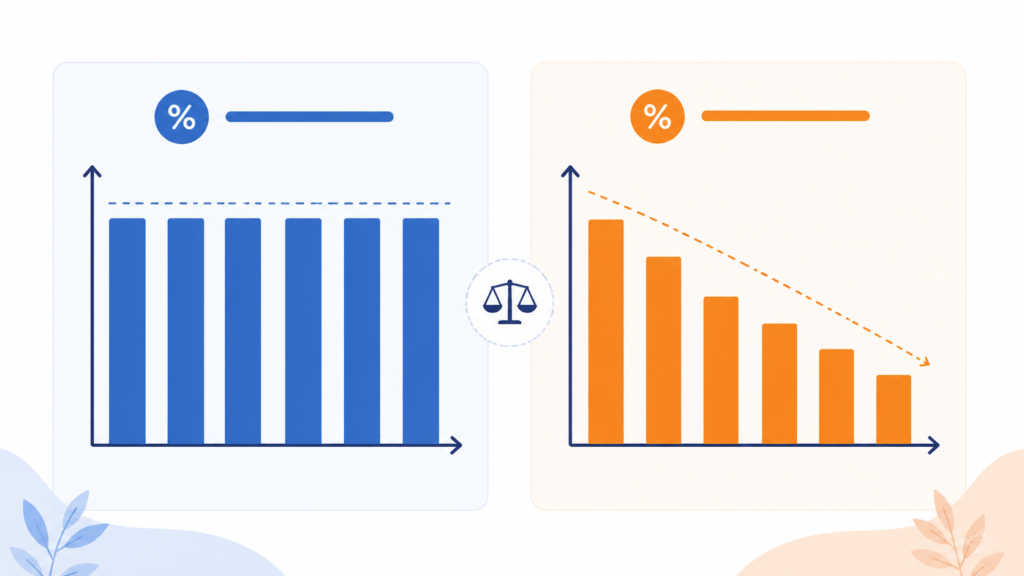
The practical effect: a flat rate of roughly 2.5% works out to an effective reducing-balance APR of about 4.7–5.0% — nearly double the number on the page. On a straightforward example: a AED 100,000 loan over 60 months at a 2.5% flat rate carries AED 2,500 in interest per year, AED 12,500 total, for a monthly payment near AED 1,875. That’s the real cost, even though “2.5%” is the figure that gets advertised.
When you’re comparing offers, ask the bank for the reducing-balance equivalent, not just the flat rate — it’s the only way to compare two loans on equal terms.
What UAE banks are quoting in 2026
Indicative starting rates (flat, per annum) from major UAE lenders as of mid-2026:
| Lender | Indicative rate (flat p.a.) |
|---|---|
| Emirates NBD | From 2.49% |
| First Abu Dhabi Bank (FAB) | From 2.59% |
| ADCB | From 2.69% |
| Mashreq | From 2.89% |
| Dubai Islamic Bank (Murabaha) | From 2.75% |
These are starting points, not guaranteed offers — your actual rate depends on salary, employer category, credit history, and the age of the vehicle. One lever worth knowing: transferring your salary to the bank you’re borrowing from typically unlocks a rate 0.5–1% lower than the standard walk-in offer. Most banks also set a minimum monthly salary threshold, commonly in the AED 5,000–7,000 range for used-car loans, though this varies by lender and existing relationship.
Islamic auto finance is a real, mainstream alternative — not a niche product
If you’ve read that the UAE lacks financing variety compared to the UK or US, it’s worth knowing that Sharia-compliant structures are widely available and function differently from a conventional interest-bearing loan:
- Murabaha — the bank buys the car and sells it to you at a disclosed, fixed mark-up, repaid in instalments. The “profit rate” replaces interest, but functions similarly in monthly cost terms.
- Ijara — closer to a lease-to-own structure, where the bank retains ownership and you pay for use of the vehicle, often with an option to take ownership at the end.
These aren’t fringe products — ADCB, Dubai Islamic Bank, ADIB, and most major UAE banks offer them alongside conventional loans, generally at comparable headline rates. If a fixed, disclosed cost structure appeals to you regardless of the religious framing, it’s worth asking for a Murabaha quote alongside a standard loan quote.
Leasing and subscriptions exist here too — they’re just less visible
It’s a common claim that the UAE doesn’t offer leasing or flexible ownership models the way mature markets do. That’s not quite accurate in 2026 — the options exist, they’re just less centrally marketed through mainstream dealer finance desks than in the UK:
- Car subscription services like Carasti and MOOV by Al-Futtaim bundle the car, insurance, maintenance, registration, and roadside assistance into one monthly fee, with no long-term commitment and no down payment in the traditional sense — Carasti plans start from roughly AED 1,199/month for economy cars, and MOOV typically asks for a refundable security deposit around AED 1,500.
- Long-term leasing providers (Renty and others) and several manufacturer-backed programs offer multi-year leases with a purchase option, lease extension, or return-and-upgrade at term end.
- Manufacturer 0%-finance and deferred-payment campaigns run periodically, especially around Ramadan and major auto shows, sometimes including payment holidays of several months.
- Zero-down-payment loans exist at select banks for salaried applicants with a direct salary-transfer account — worth asking about explicitly if a 20–30% down payment isn’t feasible right now.
None of these will look identical to a UK-style PCP contract, and coverage varies by emirate and provider, but the idea that a UAE buyer is stuck choosing only between “cash” or “one 5-year bank loan” understates what’s actually on the market this year.
New car vs. used car financing: what actually changes
Beyond the down payment gap (20% vs. 30%), a few other differences are worth planning around:
- Vehicle age limits. Most banks cap financing to cars that will be no older than roughly 7–10 years by the end of the loan term, which can shorten your effective repayment window on an older used car.
- Approval speed. New-car financing arranged through a dealership’s in-house finance desk is often faster than a used-car purchase financed independently, since dealers have direct bank relationships and pre-set paperwork.
- Rate parity. Interest rates themselves don’t usually differ much between new and used, but the higher down payment on used cars means a smaller loan principal and, often, a shorter realistic tenure.
What you’ll typically need to apply
Requirements vary slightly by bank, but plan to have:
- Valid Emirates ID and passport copy (with valid UAE residence visa, for expats)
- Salary certificate or employment letter, and recent bank statements (typically 3–6 months)
- Proof of salary transfer if you’re requesting the better rate tied to it
- A quotation or proforma invoice for the vehicle from the dealer or seller
- For self-employed applicants: trade license and audited financials, which generally means more documentation and sometimes a higher down payment expectation
A short checklist before you sign anything
- Ask for the reducing-balance APR equivalent, not just the flat rate, from every bank you compare.
- Confirm whether your down payment requirement is the 20% (new) or 30% (used) minimum, and get it in writing.
- Ask whether warranty, service package, and GAP insurance can be bundled into the monthly payment or must be paid separately upfront.
- If a 20–30% down payment is a stretch, ask specifically about salary-transfer 0%-down programs or a subscription/lease alternative before assuming a bank loan is your only route.
- Check the early-settlement terms — some UAE lenders charge an early repayment fee, typically capped by CBUAE rules, but it’s worth confirming the exact figure before you commit.
The bottom line
The 20%-down, 5-year bank loan is still the default in the UAE, but it isn’t the only option, and the headline interest rate on any offer usually understates the real cost unless you convert it to a reducing-balance figure first. Whether a conventional loan, Islamic finance, a lease, or a subscription makes the most sense depends on how long you plan to keep the car, your visa and employment status, and your monthly cash flow — a decision worth working through with your bank or a licensed financial advisor rather than deciding from a rate table alone.