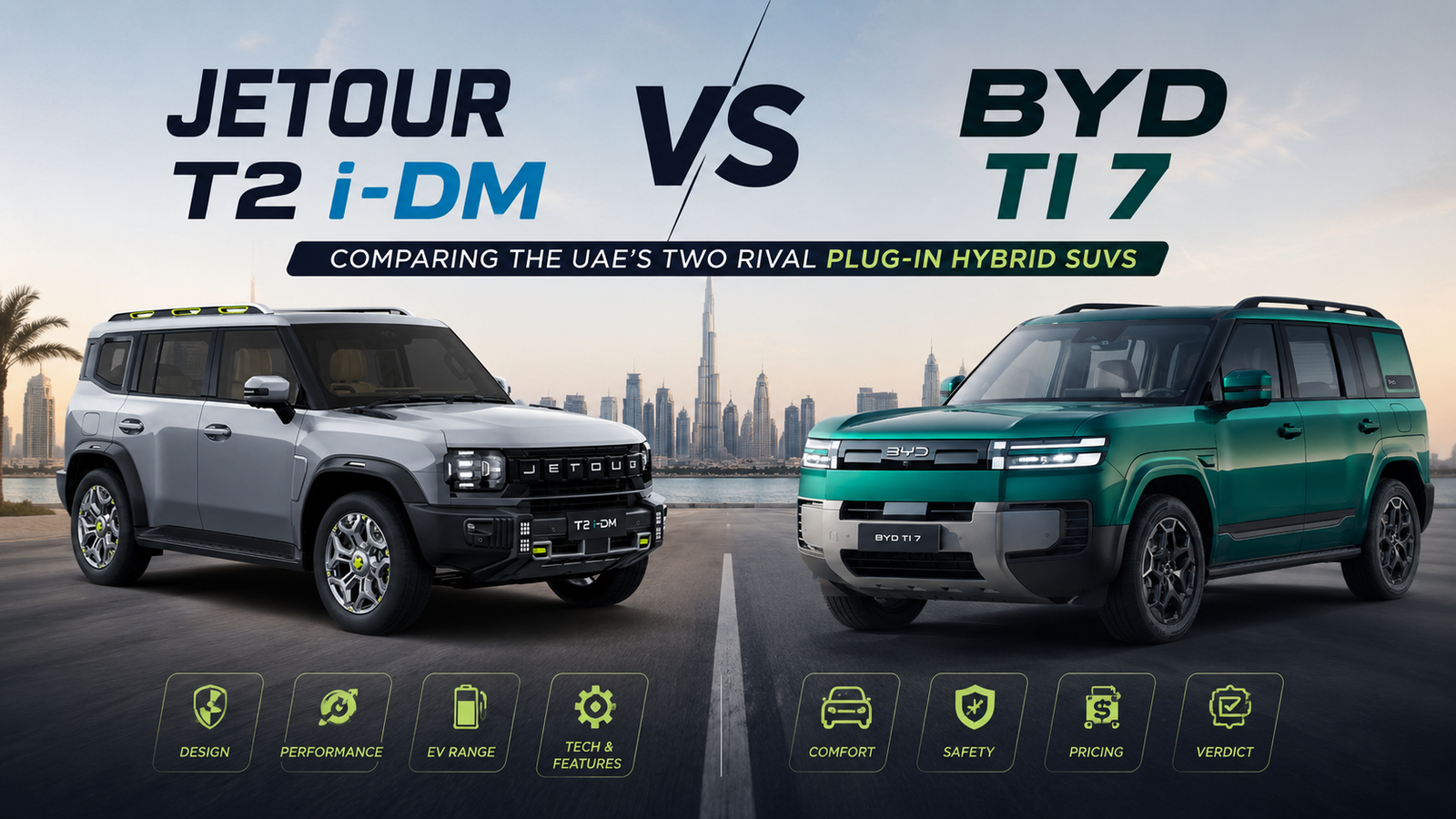
Both the Jetour T2 i-DM and the BYD Ti 7 arrived in UAE showrooms in 2026 chasing the same buyer: someone who wants SUV size, plug-in hybrid efficiency, and a price well below the established Japanese and European competition. Spec sheets alone make them look like close rivals. What actually separates them — trim-level pricing, real ownership costs, and how each brand is likely to hold its value here — gets far less coverage than the horsepower numbers.
Here’s a comparison that covers both the cars and their numbers that you need to know about:
Quick comparison
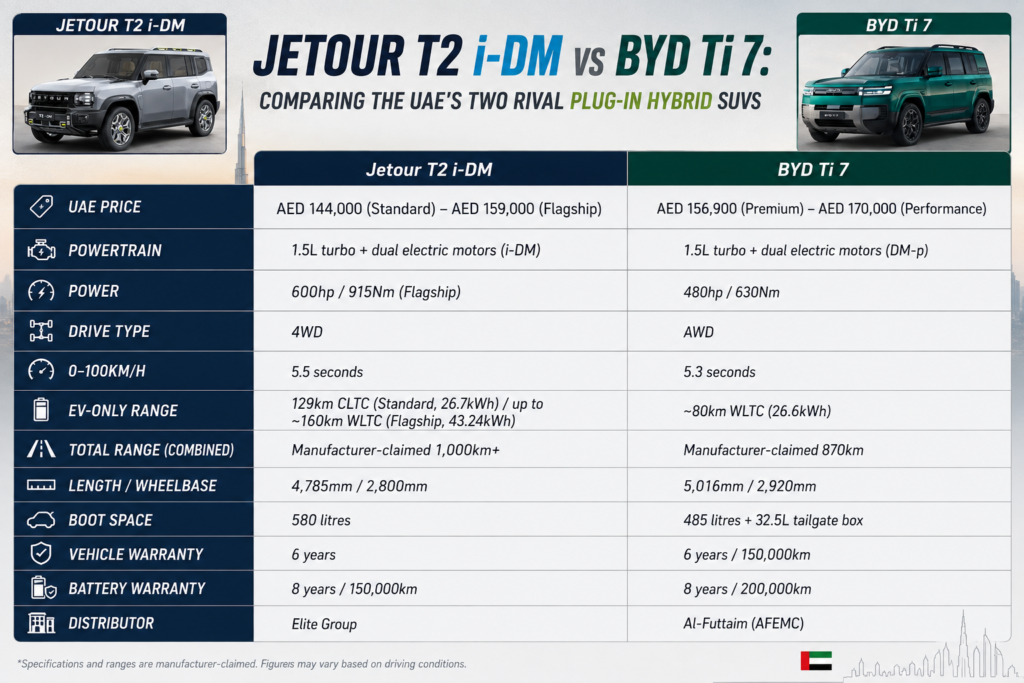
| Category | Jetour T2 i-DM | BYD Ti 7 |
|---|---|---|
| UAE price | AED 144,000 (Standard) – AED 159,000 (Flagship) | AED 156,900 (Premium) – AED 170,000 (Performance) |
| Powertrain | 1.5L turbo + dual electric motors (i-DM) | 1.5L turbo + dual electric motors (DM-p) |
| Power | 600hp / 915Nm (Flagship) | 480hp / 630Nm |
| Drive type | 4WD | AWD |
| 0–100km/h | 5.5 seconds | 5.3 seconds |
| EV-only range | 129km CLTC (Standard, 26.7kWh) / up to ~160km WLTC (Flagship, 43.24kWh) | ~80km WLTC (26.6kWh) |
| Total range (combined) | Manufacturer-claimed 1,000km+ | Manufacturer-claimed 870km |
| Length / wheelbase | 4,785mm / 2,800mm | 5,016mm / 2,920mm |
| Boot space | 580 litres | 485 litres + 32.5L tailgate box |
| Vehicle warranty | 6 years | 6 years / 150,000km |
| Battery warranty | 8 years / 150,000km | 8 years / 200,000km |
| Distributor | Elite Group | Al-Futtaim (AFEMC) |
A note on the Jetour figures: the T2 i-DM comes in two distinct configurations, not one. The Standard trim runs a smaller 26.7kWh battery good for about 129km of electric-only range (CLTC rating), while the Flagship steps up to a 43.24kWh pack for roughly double that. If you’re cross-shopping on EV range specifically, which trim you’re quoted matters as much as which car.
Design and road presence
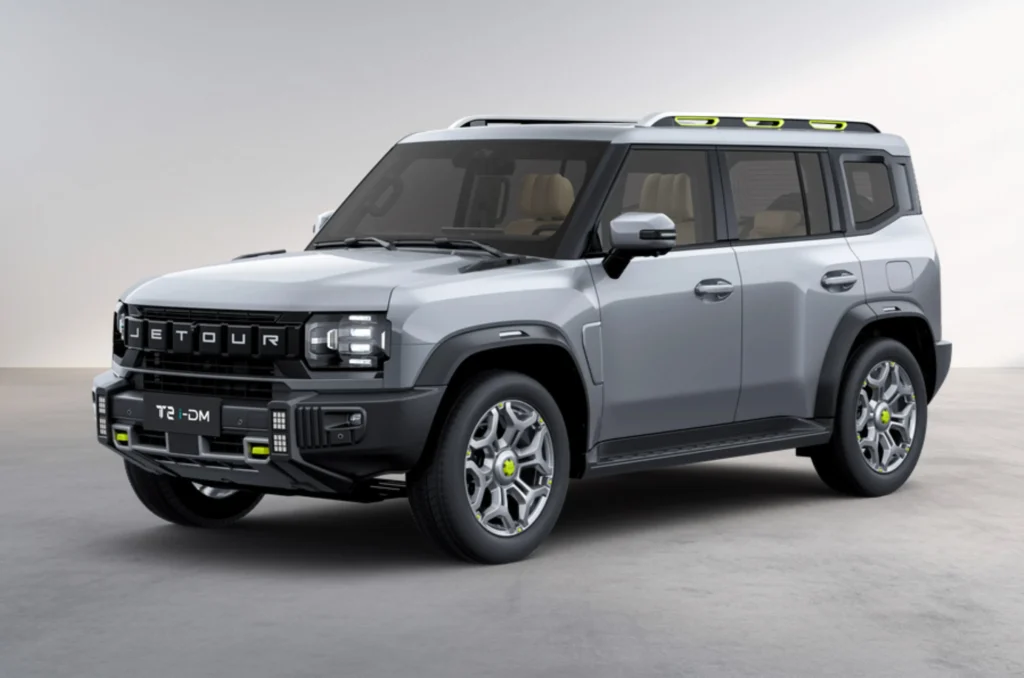
The T2 i-DM leans into rugged off-roader styling — square body, upright stance, roof rack, side steps. It reads as an SUV built for weekend desert runs as much as the school run.
The Ti 7 takes a more polished, family-lifestyle direction. It’s the longer of the two by over 200mm, with sleeker lighting and a design language closer to a premium crossover than a proper off-roader, despite sharing similar mechanical bones.
Cabin and technology
Both cars are well-equipped for the price point, which is part of why Chinese PHEVs have gained ground in the UAE so quickly. The T2 i-DM runs a 15.6-inch infotainment screen, a 10.25-inch digital cluster, a 12-speaker Sony audio system, ventilated front seats, and vehicle-to-load power output for running external devices off the battery.
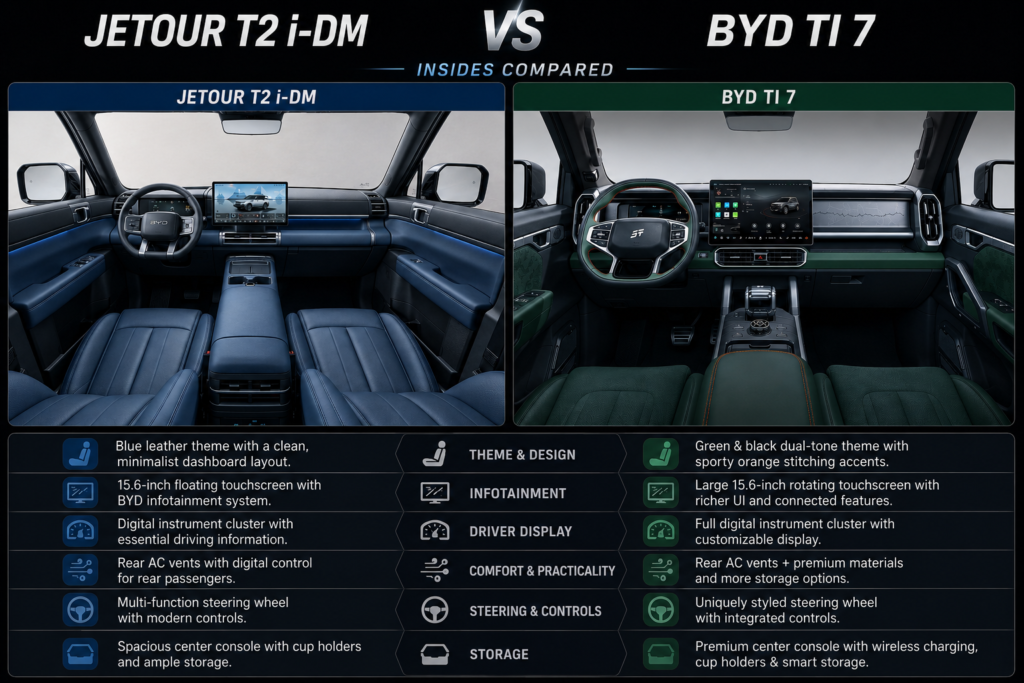
The Ti 7 matches the 15.6-inch touchscreen and adds a 14-speaker system, with higher trims bringing front-seat massage, memory seats, a built-in car refrigerator, and a 26-inch head-up display — features aimed squarely at buyers who want the cabin to feel premium, not just techy.
Performance and efficiency
The T2 i-DM’s headline number is hard to ignore: 600hp and 915Nm in Flagship trim is genuinely unusual output for an SUV in this price bracket, and its longer EV-only range means more of your daily Dubai commute can realistically run on electric power alone before the petrol engine kicks in.
The Ti 7 is marginally quicker to 100km/h (5.3 seconds vs 5.5) despite lower peak output, and BYD’s claimed 870km combined range is competitive, but its shorter ~80km electric-only range means it leans on the petrol engine sooner during daily use.
Off-road capability
Both offer real off-road hardware, not just SUV styling. The T2 i-DM has the edge on paper: over 200mm ground clearance, a 28-degree approach angle, 30-degree departure angle, and drive modes for snow, mud, sand, and rock.
The Ti 7 isn’t far behind — 190mm laden clearance, 24-degree approach, 25-degree departure, plus tank-turn and crawl modes — but its longer overhangs and family-SUV proportions make it noticeably less suited to serious dune or rock work than the Jetour.
What ownership actually costs — beyond the sticker price
This is the part most comparisons skip, and it changes the calculus for a lot of buyers.
Servicing. Al-Futtaim bundles 5 years or 75,000km of free scheduled servicing with new BYD plug-in hybrids through AFEMC — a real saving that isn’t reflected anywhere in the sticker price. Jetour’s package through Elite Group covers 3 years or 30,000km of service. Over a typical ownership period, that gap is worth factoring into your total cost comparison, not just the warranty length.
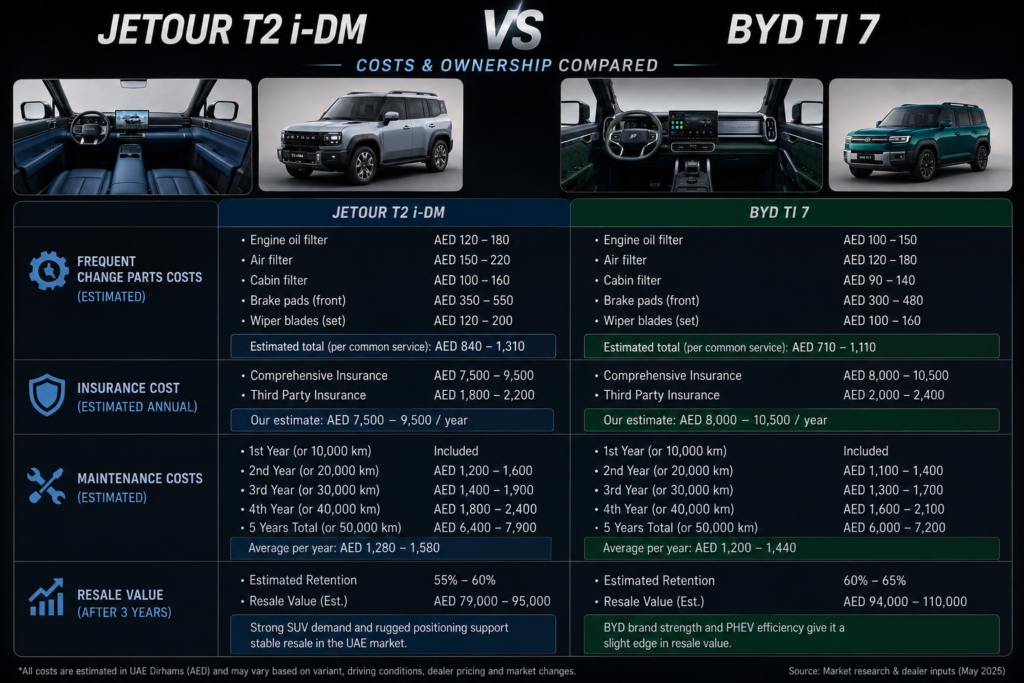
Insurance. UAE comprehensive insurance is priced partly on engine size, horsepower, and vehicle category, and SUVs generally carry a premium of roughly AED 300–800 over equivalent sedans. The T2 i-DM Flagship’s 600hp output sits well above the BYD’s 480hp, and insurers in the UAE do factor peak power into risk pricing — so it’s worth getting an actual quote on both before assuming the cheaper car on paper is the cheaper car to run.
Resale value. Both brands are still building a track record in the UAE’s used car market, and it’s honest to say neither has the resale history of a Toyota or Nissan yet. Broadly, Chinese-brand vehicles in the UAE have been retaining around 60–70% of value after three years, compared with roughly 75–85% for established Japanese brands — a real gap, though narrower than early skeptics predicted, and BYD’s residuals specifically have been trending upward as EV and PHEV adoption grows and the Al-Futtaim network expands. Jetour’s T2 range already shows a functioning secondary market in the UAE, with used listings spanning roughly AED 87,500 to AED 149,750, which suggests reasonable liquidity for a brand that’s only been here a few years.
None of this means either car is a bad buy — it means neither should be evaluated purely on the new-car price if you plan to sell or trade in within five years.
Which one actually fits you
If your priorities are stronger performance, a longer EV-only commute, and more off-road capability at a lower entry price, the T2 i-DM Standard or Flagship makes the stronger case, especially once you weigh in Jetour’s longer engine and vehicle warranty terms.
If you want more cabin and rear-seat space, a more premium-feeling interior, marginally quicker acceleration, and lower ongoing service costs thanks to BYD’s free servicing package, the Ti 7 is the better fit — accepting that you’ll pay slightly more upfront and get less time running on electric power alone day to day.
Neither is the objectively “better” SUV — they’re built around different priorities, and the right one depends on how you’d actually use it.
Frequently asked questions
Which is faster, the Jetour T2 i-DM or the BYD Ti 7?
The BYD Ti 7 is marginally quicker on paper, at 5.3 seconds 0–100km/h versus 5.5 seconds for the T2 i-DM, despite producing less peak horsepower.
Which has better electric-only range?
The Jetour T2 i-DM, by a wide margin — up to roughly 160km WLTC on the Flagship’s larger battery, compared with about 80km WLTC for the BYD Ti 7.
Which is cheaper to service in the UAE?
BYD’s Ti 7 comes with 5 years/75,000km of free scheduled servicing through Al-Futtaim, versus 3 years/30,000km for the Jetour T2 i-DM through Elite Group — a meaningful gap in total ownership cost.
Does the higher horsepower of the Jetour affect insurance costs?
It can. UAE insurers factor engine power and vehicle category into premiums, and the T2 i-DM’s 600hp puts it well above the Ti 7’s 480hp, so it’s worth comparing actual insurance quotes rather than assuming the lower-priced car is cheaper to run overall.
Do either of these SUVs hold their value well in the UAE?
Both brands are still establishing a resale track record here. Chinese-brand vehicles broadly retain less value than Toyota or Nissan over three years, though the gap has narrowed and BYD’s residuals in particular have been improving as the brand’s presence grows.