“Electric cars cost less to run” is true, but it’s not a number you can budget around. What you actually need are the AED figures — what a kWh costs at home versus at a public charger, what a real annual service bill looks like, and how that stacks up against what you’re paying at the pump today. Here’s the ownership cost picture with the numbers filled in, using current DEWA tariffs and UAE market data rather than general claims.
What charging actually costs
This is the number every EV cost guide should lead with and most don’t. DEWA prices home electricity on a tiered residential scale, and the tier you land in depends on your household’s total monthly usage, not just the car:
| Monthly usage | Rate per kWh |
|---|---|
| 0–2,000 kWh | AED 0.23 |
| 2,001–4,000 kWh | AED 0.28 |
| 4,001–6,000 kWh | AED 0.32 |
| Above 6,000 kWh | AED 0.38 |
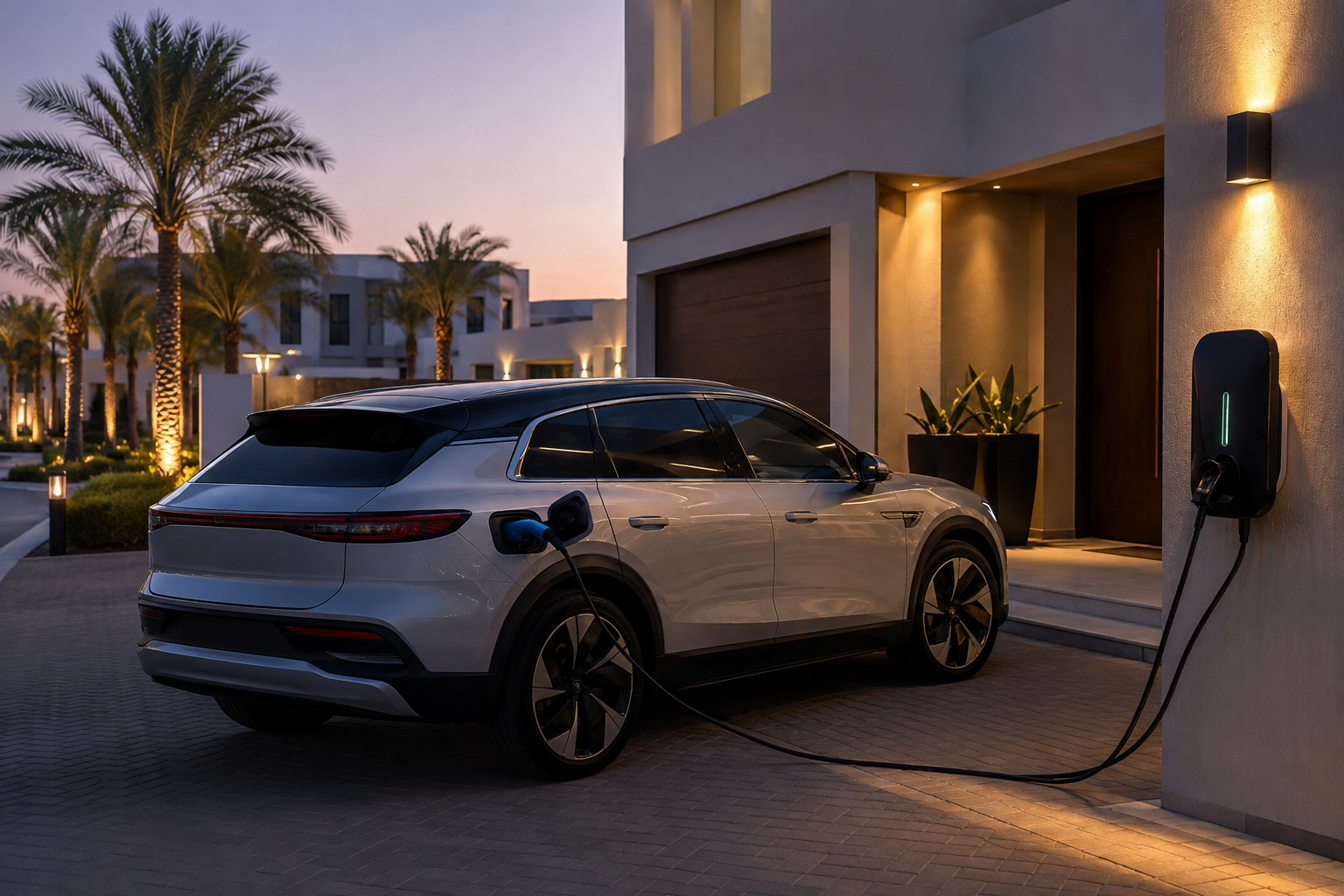
Charging an EV typically adds a few hundred kWh a month to a household’s usage, so most owners end up paying somewhere in the AED 0.23–0.28 range for the added consumption, unless their home is already a high-consumption household pushing into higher tiers. As a concrete anchor: charging a 75kWh battery (roughly a Tesla Model Y-sized pack) from empty at home costs around AED 22 at blended residential rates.
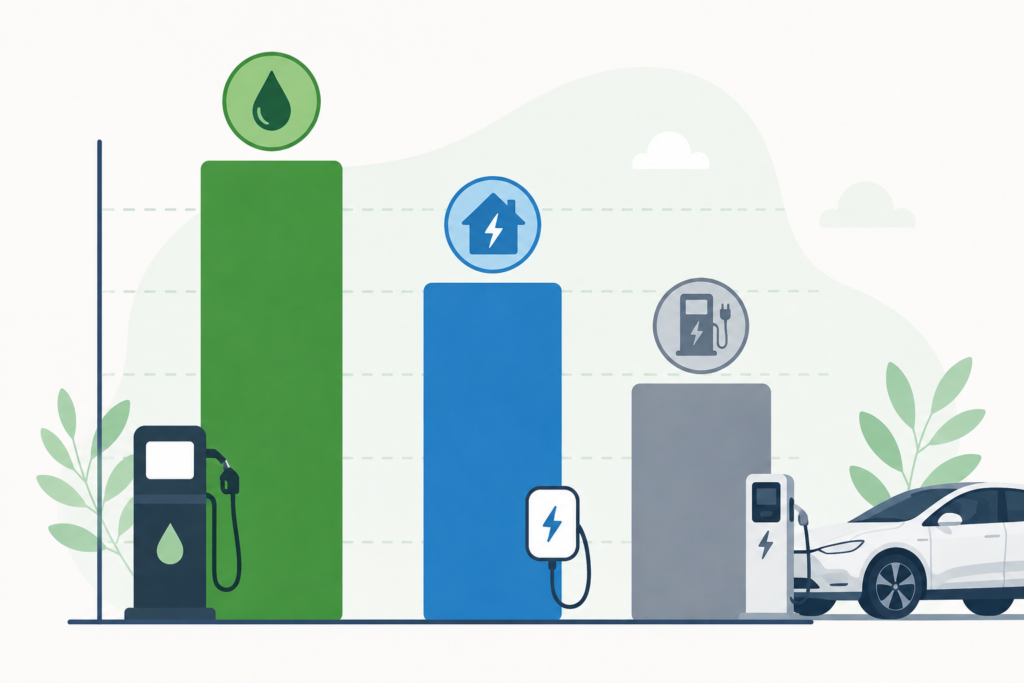
Public charging costs more. DEWA’s Green Charger network prices standard AC charging around AED 0.29/kWh and DC fast charging in the AED 0.48–0.55/kWh range under its standard published tariff — though DEWA ran a promotion offering free charging for the first year to newly registered users starting February 2026, and some public tariff tiers have been reported as high as AED 0.70–1.20/kWh outside that promotion. Public charging pricing has moved around enough recently that it’s worth checking DEWA’s current published rates before you budget around a specific figure.
The cost-per-km comparison nobody puts in AED
Using August 2026 fuel prices (Special 95 at AED 3.49/litre) and a typical mid-size SUV averaging 8 litres per 100km, alongside a premium electric SUV averaging roughly 18kWh per 100km:
| Fuel type | Cost per km | Cost per 100km |
|---|---|---|
| Petrol (Special 95) | ~AED 0.28 | ~AED 28 |
| EV, home charging (mid-tier rate) | ~AED 0.05 | ~AED 5 |
| EV, public DC fast charging | ~AED 0.09 | ~AED 9 |
Charging at home works out to roughly a fifth of the per-km cost of petrol; relying on public fast charging narrows that gap but still comes in well under half the cost of fuel. The practical takeaway: an EV’s running-cost advantage depends heavily on how much of your charging happens at home versus on the road, so a driver without home charging access won’t see the full saving these headline comparisons imply.
Installing a home charger
Expect to pay somewhere between AED 1,199 and AED 9,000 for a home wallbox installation, with the wide range driven by the unit itself, the cable run from your electrical panel, and whether any panel upgrade is needed. Budget installs from providers offering standard setups start around AED 1,199–2,000; a full installation with a premium wallbox and longer cable run can run AED 5,000–9,000. Most installations are completed in a single visit of three to five hours.
What servicing actually costs
Real figures beat vague “fewer moving parts” claims. Annual EV service costs in the UAE generally run:
- BYD: roughly AED 1,500–3,000 per year in sticker cost, though Al-Futtaim’s AFEMC bundles up to 5 years or 100,000km of free scheduled servicing with new BYD EVs, meaning many owners pay close to nothing out of pocket during that window.
- Tesla: around AED 1,200 for a standard annual service including a battery check, rising to roughly AED 3,200 for more specialised service needs.
For comparison, mainstream petrol vehicle servicing in the UAE commonly runs a similar AED 1,500–3,000 range annually, but luxury and performance petrol brands can run considerably higher once you add oil changes, filters, spark plugs, and exhaust work that EVs simply don’t need. The service-cost gap between EVs and petrol cars is real but brand-dependent — it isn’t automatically dramatic unless you’re comparing against a premium petrol marque.
Insurance: what actually moves the price
EV insurance in the UAE is priced on the same broad factors as any comprehensive policy — vehicle value, repair complexity, and claims risk — with a few EV-specific wrinkles. Comprehensive premiums in the UAE typically run 1.5–3% of a vehicle’s market value annually, and battery replacement cost (which can be substantial if it isn’t covered separately under the manufacturer’s battery warranty) is a factor insurers weigh when pricing EV-specific policies. Advanced driver-assistance and sensor packages on premium EVs can also raise repair costs after a claim, which insurers price in. Get a real quote before assuming an EV is automatically cheaper or more expensive to insure than the petrol equivalent — it varies by model.
Government incentives that actually offset cost
These are concrete and current as of 2026, not vague “government support”:
- Free Salik tag on registration for EV owners, available at any of the 13 Salik service centres — note that this waives the tag issuance cost, not the toll itself; every Salik gate passage still costs the standard AED 4.
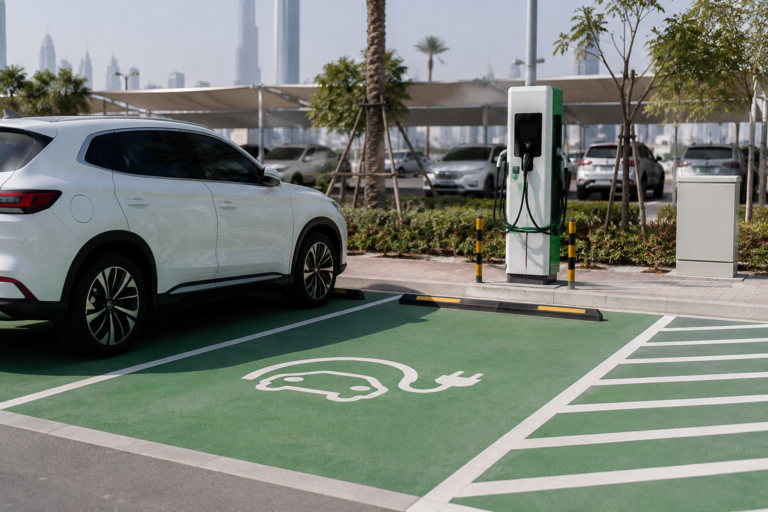
- Free parking in designated green-marked EV bays across Dubai, typically capped at a 4-hour limit before standard charges or fines apply.
- Temporary exemption from vehicle registration and renewal fees for registered EV owners in Dubai.
Abu Dhabi and Sharjah are rolling out comparable measures, but perks in one emirate don’t automatically carry over to another — Dubai’s free parking and Salik tag benefits, for instance, don’t apply once you’re driving in Abu Dhabi.
Does UAE heat actually hurt EV costs?
It affects efficiency more than it threatens the battery outright. Higher AC load and cooling-system demand in summer reduce real-world range and can modestly increase electricity use per km compared to cooler-climate driving. Modern EVs sold in the UAE come with active thermal management systems specifically designed to protect battery health in extreme heat, which is why manufacturers offer multi-year, high-mileage battery warranties (commonly 8 years and upward across brands sold here) rather than treating heat degradation as an open question. It’s a real factor in day-to-day efficiency, not the ownership-cost risk it’s sometimes made out to be.
Putting it together: an illustrative annual comparison
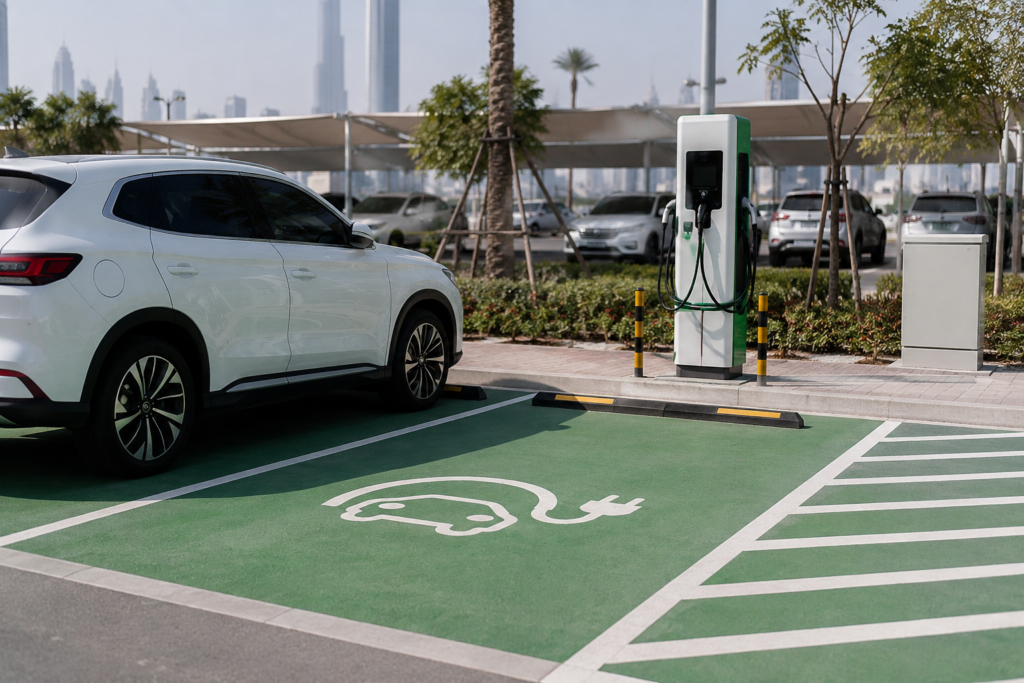
For a driver covering roughly 20,000km a year with mostly home charging, here’s a rough order-of-magnitude picture (fuel/charging plus servicing only — excluding insurance and purchase price, which vary too much by model to generalise):
| Petrol SUV | EV (home charging) | |
|---|---|---|
| Annual fuel/charging cost | ~AED 5,600 | ~AED 1,000 |
| Annual servicing | ~AED 2,000–3,000 | ~AED 1,500–3,000 (often free under warranty) |
| Rough annual total | ~AED 7,600–8,600 | ~AED 1,000–4,000 |
Over five years, that gap compounds into a meaningful saving — but it’s worth being honest about what this leaves out: EVs typically still carry a higher upfront purchase price than a comparable petrol car in the UAE, and resale value for many EV brands here is still an unproven, developing market rather than a settled one. The running-cost advantage is real and well-documented; whether it outweighs the higher entry price and less certain resale depends on how long you plan to keep the car and how much of your driving happens at home-charging range.
Frequently asked questions
How much does it cost to charge an electric car at home in the UAE?
Using DEWA’s tiered residential rates (AED 0.23–0.38/kWh depending on total household usage), a full charge of a roughly 75kWh battery costs around AED 22 at typical blended rates — a fraction of an equivalent petrol fill-up.
Is public EV charging more expensive than charging at home in the UAE?
Yes, noticeably. DEWA’s public Green Charger network prices DC fast charging around AED 0.48–0.55/kWh under its standard tariff, compared to AED 0.23–0.28/kWh for most home charging — though promotional periods have offered free public charging for newly registered users.
Do EV owners in Dubai get free tolls?
Not exactly — EV owners get a free Salik tag on registration, but each toll gate passage still costs the standard AED 4. The benefit is the tag itself, not toll-free driving.
Is EV servicing actually cheaper than petrol car servicing in the UAE?
Generally yes, since EVs skip oil changes, spark plugs, and exhaust work, but the gap varies by brand. Mainstream EV and petrol servicing both commonly fall in the AED 1,500–3,000/year range; the bigger EV advantage shows up against premium petrol brands, and some EV makers bundle years of free servicing that petrol brands rarely match.
Does UAE heat damage EV batteries faster?
Modern EVs use active thermal management systems specifically to protect battery health in high heat, and most come with 8-year-plus battery warranties. Heat affects real-world efficiency and range more than it threatens long-term battery health.