Buying car insurance in the UAE is more than a legal requirement – it is an important financial decision. Whether you’re buying a new car, insuring a used vehicle or renewing an existing policy, the right coverage can protect you against accident-related expenses, theft and third-party claims.
However, choosing a policy based only on its premium can be costly. Differences in deductibles, agency repairs, geographical coverage and exclusions can significantly affect what you pay when you make a claim.
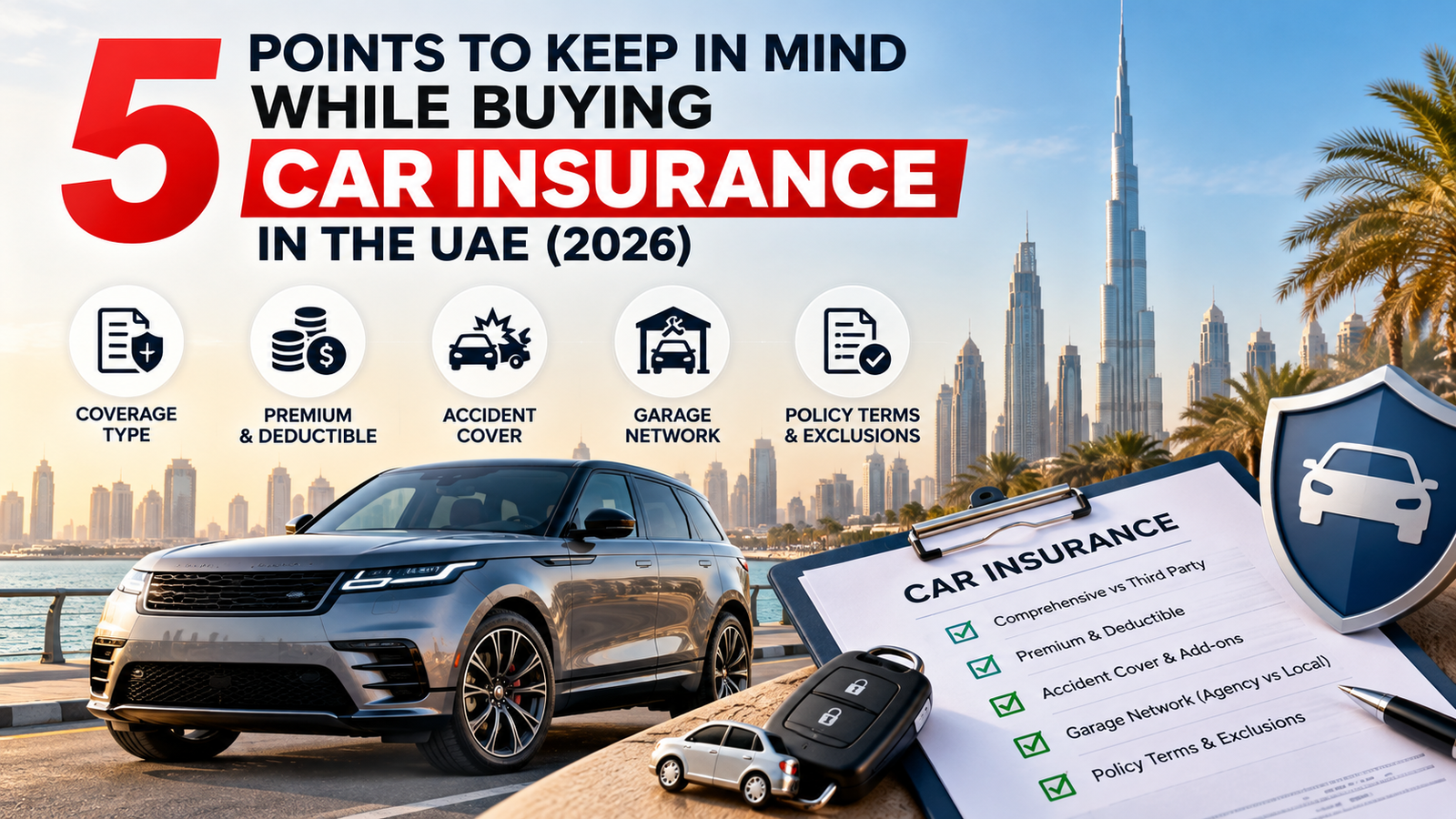
Here are five essential points to consider before buying car insurance in the UAE in 2026.
1. Understand the Difference Between Third-Party and Comprehensive Insurance
Third-party liability insurance
This is the basic motor insurance cover required for vehicles used on UAE roads. It covers eligible legal liabilities for injury or property damage caused to other parties, subject to the policy terms. It generally does not cover damage to your own car.
Comprehensive insurance
This typically includes third-party liability and cover for damage to your own vehicle from insured events, subject to exclusions and the policy wording. Theft, fire, natural hazards and other benefits depend on the specific policy.
Which one should you choose?
- Consider comprehensive cover for a newer, expensive or financed vehicle, where repairing or replacing your car could be financially difficult.
- Third-party cover may be worth considering for an older car with a relatively low market value, provided you can afford to pay for damage to your own vehicle.
- If your car is financed, check the lender’s insurance requirements before purchasing a policy.
Don’t assume every comprehensive policy offers identical protection. Check the insured events and exclusions before comparing premiums.
2. Check the Deductible or Excess Before Buying
The deductible, often called the excess, is the amount you may need to contribute toward an eligible claim.
For example, suppose your policy has a deductible of AED 1,000 and an eligible repair costs AED 6,000. If the deductible applies to that claim, you would generally pay AED 1,000 and the insurer would cover the remaining AED 5,000, subject to the policy terms.
Before purchasing, check:
- The standard deductible for accidental damage.
- Whether a higher excess applies to young or inexperienced drivers.
- Whether separate deductibles apply to specific events or benefits.
- Whether the excess changes if you use a non-approved repairer.
- Whether the premium savings from a higher deductible are worth the additional financial risk.
Practical tip: Don’t choose a policy with a high excess just to save a small amount on the annual premium. Make sure you could comfortably afford that excess if you needed to claim.
3. Confirm Agency Repair vs. Non-Agency Repair
The repair option can make a substantial difference, particularly if you own a new or premium vehicle.
| Feature | Agency repair | Non-agency repair |
|---|---|---|
| Repair location | Manufacturer’s authorised workshop, subject to policy terms | Insurer-approved or other specified garages |
| Cost | Usually more expensive | Often more affordable |
| Parts and expertise | Manufacturer-authorised service arrangements | Depends on the selected garage and policy |
| Availability | Depends on insurer, car age and policy | Depends on insurer’s approved network |
| Best suited for | Owners prioritising authorised repairs | Owners prioritising lower premiums |
Some policies offer agency repair only for a limited period after the vehicle’s first registration. Others may offer it as an optional benefit or under different eligibility rules.
Before paying, ask the insurer:
- Is agency repair included for my car’s model year?
- Is it available throughout the policy period?
- Are genuine parts guaranteed where applicable?
- What happens if the authorised workshop is unavailable?
- Will I pay a higher excess if I choose a different garage?
For newer vehicles, the extra cost of agency repair may be worthwhile. For an older vehicle, a reputable approved workshop may provide better overall value.
4. Read the Exclusions and Optional Benefits Carefully
A policy’s exclusions determine when the insurer may decline or limit a claim. Two policies with similar premiums can offer different levels of protection.
Review these areas before purchasing:
- Natural hazards: Check whether flooding, storms and other natural events are covered, and understand any exclusions or conditions.
- Personal accident benefits: Confirm whether the policy covers the driver, passengers or both, and what limits apply.
- Roadside assistance: Check whether breakdown support, towing and battery assistance are included or sold separately.
- Oman and other geographical extensions: If you plan to drive outside the UAE, confirm the exact territories covered and whether additional documentation or cover is required.
- Windscreen and accessories: Check the limits for glass damage, audio equipment and other accessories.
- Replacement car: Verify whether a courtesy vehicle is included, for how long and under what conditions.
- Off-road driving: If you drive in the desert, confirm whether the policy covers the intended activity. Ordinary road insurance may exclude certain off-road incidents.
Never rely solely on a salesperson’s verbal assurance. Request written confirmation of important benefits and exclusions.
5. Compare the Total Premium, Insurer and Claims Process
The cheapest quote isn’t automatically the best deal. Compare policies on the same coverage basis and assess how claims are handled.
Before buying, compare:
| What to check | Why it matters |
|---|---|
| Annual premium and VAT | Establishes the actual amount payable |
| Deductible | Determines your potential out-of-pocket contribution |
| Repair network | Affects where and how your car can be repaired |
| Claim requirements | Shows which documents and reporting steps are needed |
| No-claims discount | May reduce future premiums, subject to eligibility |
| Insurer and intermediary | Helps you verify the relevant regulated entities |
| Renewal terms | Helps you anticipate future cost changes |
Check that the insurer is appropriately licensed or authorised in the UAE, and review the policy schedule and full wording before paying.
When comparing quotes, provide consistent details about the car, its use, drivers and claims history. Otherwise, the quotes may not be directly comparable.
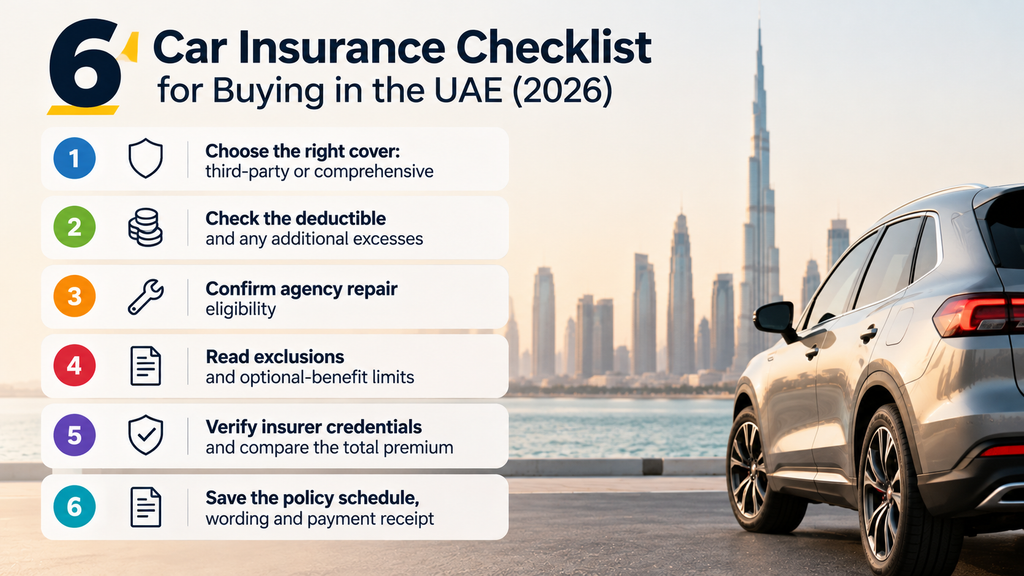
Final Checklist Before You Buy
Car insurance checklist
- Choose the right cover: third-party or comprehensive
- Check the deductible and any additional excesses
- Confirm agency repair eligibility
- Read exclusions and optional-benefit limits
- Verify insurer credentials and compare the total premium
- Save the policy schedule, wording and payment receipt
Copy checklist
The bottom line: When buying car insurance in the UAE, focus on the protection you receive, the amount you may need to pay during a claim, the repair arrangements and the policy exclusions — not just the headline premium.
A little extra time spent comparing policy wording today can help prevent costly surprises later.