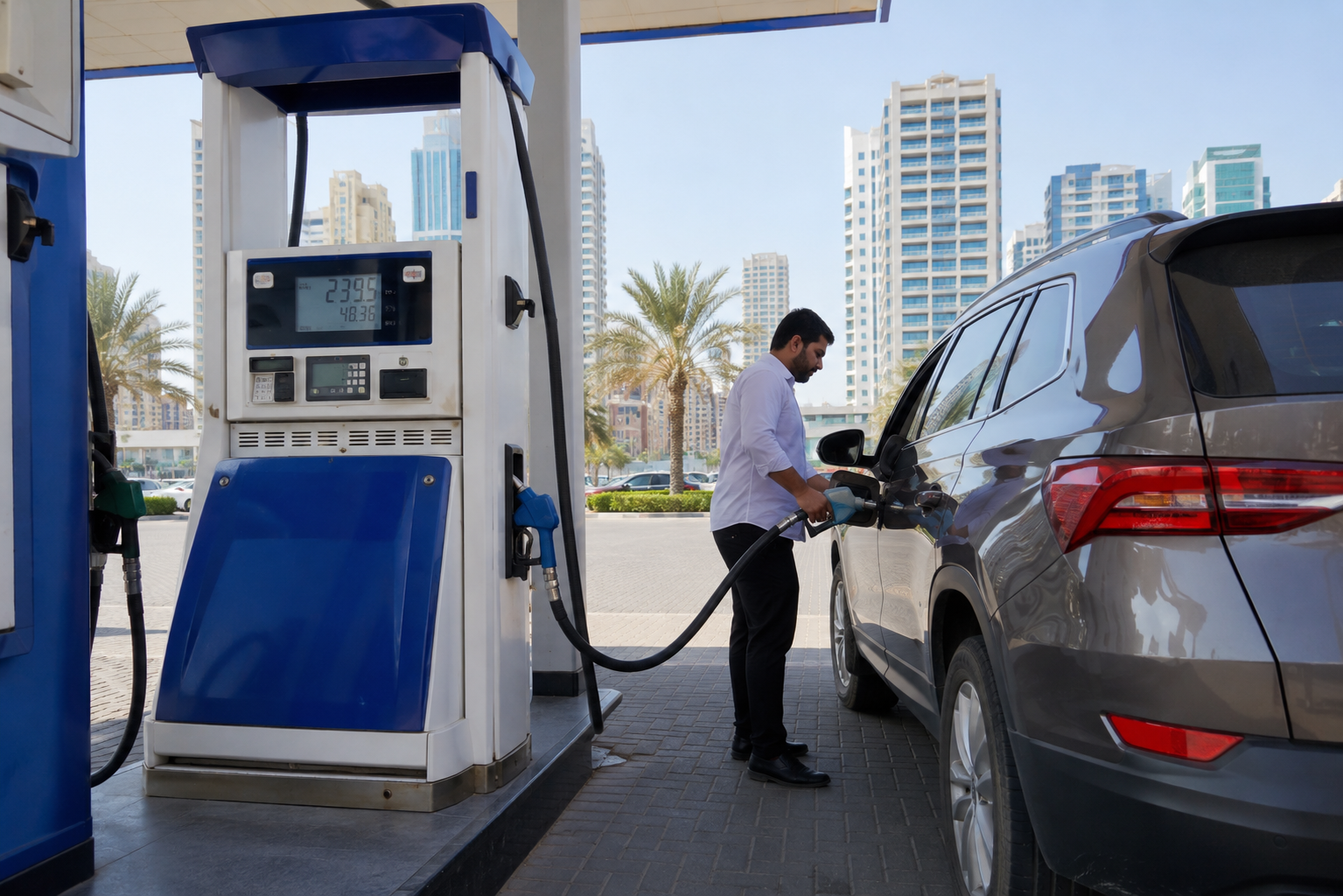
If you filled up in Dubai or Abu Dhabi this week, you probably noticed the total came in higher than last month. The UAE Petrol Prices Committee raised petrol and diesel rates for August 2026, and the increase is a meaningful one — not the small monthly nudge drivers have gotten used to.
August 2026 fuel prices in the UAE
| Fuel grade | Price per litre (Aug 2026) | Change from July |
|---|---|---|
| E-Plus 91 | AED 3.41 | +6.23% |
| Special 95 | AED 3.49 | +6.08% |
| Super 98 | AED 3.60 | +5.88% |
| Diesel | AED 3.80 | +5.56% |
These rates took effect on August 1 and apply uniformly across ADNOC (Abu Dhabi), ENOC (Dubai) and EPPCO (Northern Emirates) stations. Interestingly, the increase isn’t flat in dirham terms — E-Plus 91 rose the fastest in percentage terms even though it’s the cheapest grade, while diesel, which had the largest drop in July, saw the smallest percentage bump this time.
Why UAE Petrol prices jumped this month
The short answer: crude oil got more expensive, and the UAE’s pricing system passes that through almost immediately.
UAE fuel prices aren’t set arbitrarily — they track international crude benchmarks with roughly a one-month lag, a system in place since the government deregulated fuel pricing in September 2015. In the run-up to the August pricing decision, Brent crude spiked as high as $100.78 a barrel and WTI touched $91.78, driven by renewed fears over shipping security in the Strait of Hormuz and reports of attacks on tankers near Saudi waters. When the benchmark month-end average moves that much, the Fuel Price Committee’s formula moves with it.
There’s a second, structural piece worth knowing: on May 1, 2026, the UAE ended its 59-year OPEC membership, citing a need for more control over its own production levels after investing roughly $150 billion to expand capacity. Leaving OPEC doesn’t insulate the UAE from global price swings — pump prices are still tied to international crude — but it does change how much sway the UAE has over its own output going forward, which analysts expect to matter more for price stability over the next year or two than it did this particular month.
How this month fits into 2026 so far
Fuel prices in the UAE have been unusually volatile this year, more so than most drivers will remember. Petrol dipped in January and February, then spiked hard in April — petrol jumped roughly AED 0.80 and diesel nearly AED 2.00 in a single month — as the regional security situation deteriorated. Prices peaked in June near 2022 highs, eased back in July as tensions cooled, and have now turned upward again in August.
The pattern says less about any single month and more about the underlying driver: geopolitical risk in the Gulf is currently the single biggest swing factor in what you pay at the pump, more than seasonal demand or refining costs.
What the increase actually costs you
Numbers on a chart don’t always translate to what you feel at the till. For context:
- A 40-litre tank (a typical mid-size sedan) costs about AED 8 more to fill than it did in July.
- A 120-litre tank (a full-size SUV or pickup) costs about AED 24 more.
- Someone who fills a 60-litre tank twice a month is looking at roughly AED 24 extra per month, or close to AED 290 a year, if prices hold at this level.
That’s a manageable hit for most households, but it compounds if you’re also driving a larger vehicle or commuting long distances daily.
How UAE petrol prices compare to the rest of the Gulf
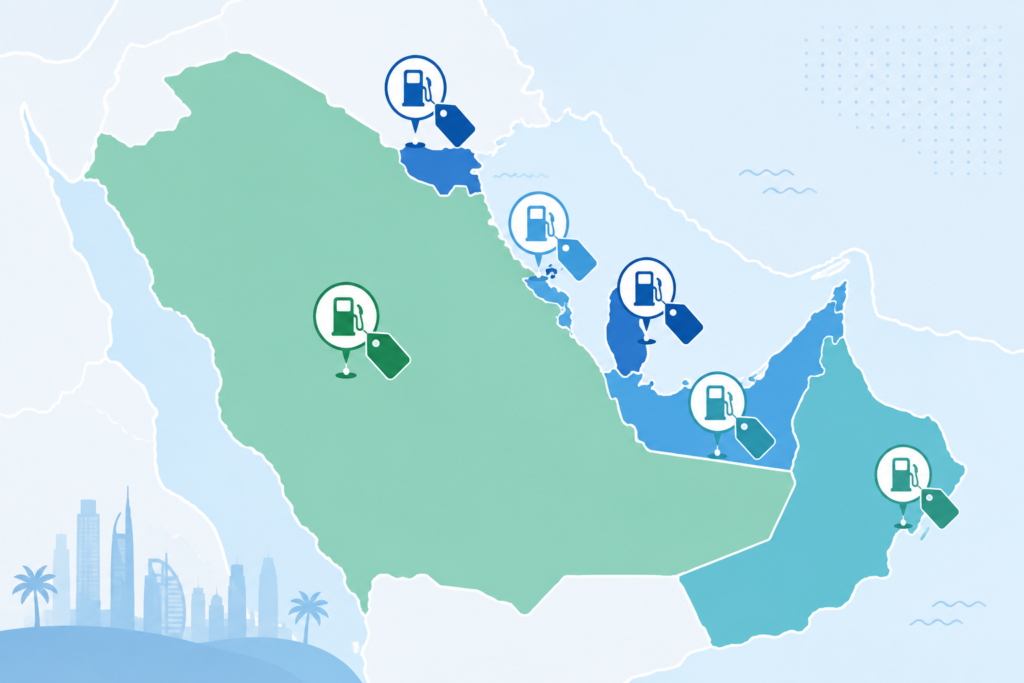
This is the part most fuel-price roundups skip, and it’s worth knowing if you’re weighing whether the UAE’s rates are “expensive.” As of July 2026 figures, the UAE was not the cheapest place to fill up in the GCC:
| Country | Approx. equivalent grade | Price per litre (AED) |
|---|---|---|
| Qatar | Premium 91 | ~2.07 |
| Bahrain | 91 octane | ~2.17 |
| Oman | Mogas 91 | ~2.20 |
| UAE | E-Plus 91 | 3.21 (July) / 3.41 (Aug) |
Qatar, Bahrain, Oman, Saudi Arabia and Kuwait all keep pump prices lower through some degree of state subsidy. The UAE deliberately moved away from that model in 2015 in favour of a transparent, market-linked mechanism — the trade-off is that UAE drivers feel global crude swings faster and more fully than their neighbours, but they also benefit just as quickly when oil prices ease, as happened in July.
Choosing the right octane for your car
Octane rating isn’t a performance upgrade you can buy your way into — it’s a spec your engine either needs or doesn’t:
- E-Plus 91 — the base grade, built for standard commuter engines with lower compression ratios. Using it in a car that doesn’t need higher octane isn’t wasteful; using a car that requires 95 or 98 on 91 can cause knocking and long-term engine wear.
- Special 95 — the default for most mainstream sedans and SUVs sold in the UAE.
- Super 98 — required by higher-compression, performance-tuned, and many turbocharged engines to prevent pre-ignition (knock).
- Diesel — used across trucks, buses, and diesel-engine SUVs and pickups.
Check your fuel filler cap or owner’s manual rather than guessing — manufacturers specify a minimum octane requirement, not a recommendation you can freely downgrade from.
Practical ways to soften the impact
None of these require a new car or a lifestyle change, just a few habits that add up over a full tank:
- Smooth throttle inputs. Aggressive acceleration and hard braking burn noticeably more fuel than anticipatory, steady driving in city traffic.
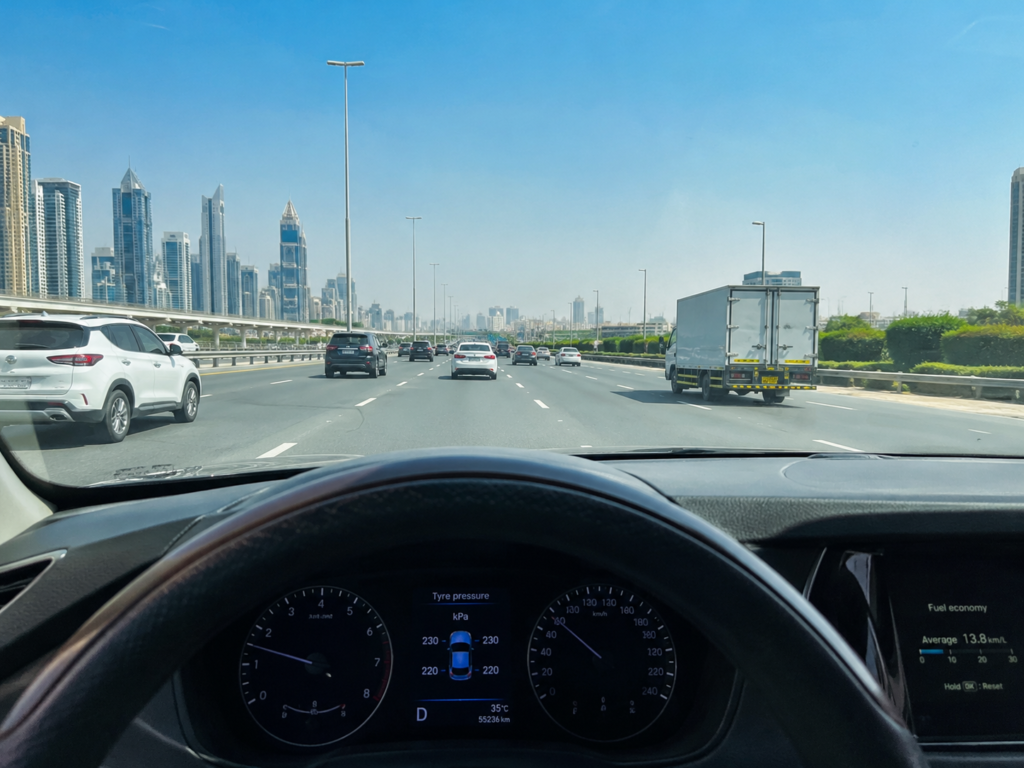
- Correct tyre pressure. Under-inflated tyres increase rolling resistance; check monthly, especially as UAE summer heat affects pressure readings.
- Minimize idling. In UAE heat it’s tempting to leave the AC running in a parked car, but extended idling burns fuel for zero distance travelled.
- Cut unnecessary weight. Roof boxes, unused gear, and cargo you’re not using that week all cost you real fuel over a month of driving.
- Use cruise control on highways like Sheikh Zayed Road or E11, where maintaining a constant speed beats the stop-start pattern of manual throttle control.
- Time your fill-ups. Since prices are announced on the last day of each month for the next, topping up before a known increase (and holding off before an expected drop) is a legitimate way to manage cost — provided you’re not driving out of your way to do it.
- Use station reward programs. ADNOC’s rewards program and ENOC’s Yes Rewards both return cashback or points on fuel spend at no added cost to enroll.
What could happen in September 2026
Here’s the honest answer, not a confident-sounding guess: nobody outside the Fuel Price Committee knows for certain, and anyone claiming otherwise is speculating. September rates depend on where Brent and WTI average out through the rest of August, which in turn depends heavily on whether Gulf shipping tensions ease or escalate further. If crude prices stabilize or pull back from their recent spike, a flat or slightly lower September rate is plausible. If tanker incidents continue, another increase is just as plausible. The official number will be published on August 31, 2026, as it is every month.
Frequently asked questions
What is the petrol price in the UAE right now?
As of August 2026: AED 3.41 for E-Plus 91, AED 3.49 for Special 95, AED 3.60 for Super 98, and AED 3.80 for diesel, all per litre.
Why did UAE fuel prices increase in August 2026?
Global crude oil prices rose sharply in the weeks before the announcement, driven by security concerns around Gulf shipping routes. Because UAE fuel prices are pegged to international crude with roughly a month’s lag, that spike fed directly into the August rates.
Is UAE petrol expensive compared to other Gulf countries?
Yes, relative to Qatar, Bahrain, Oman, Saudi Arabia and Kuwait, which subsidize fuel more heavily. The UAE uses a market-linked pricing model instead, so it’s typically higher than its GCC neighbours but adjusts both up and down with the global market.
Will UAE fuel prices go up or down in September 2026?
It isn’t confirmed either way. The direction depends on how crude oil trades through the rest of August. The official September rate is announced on August 31.
How do I know which fuel grade my car needs?
Check the fuel filler cap or your owner’s manual. Using a lower octane than your engine requires can cause knocking and long-term damage; using a higher grade than required doesn’t hurt but doesn’t help either — you’re just paying more for nothing.